Children with Autistic Spectrum Disorder are in all schools! The children who present with this disorder can be exceptionally quiet and withdrawn, or can be excessively loud, bossy and smart, and so are often undetected at mainstream schools. I know Pinelands North had many children with ASD before we acknowledged that some children had 'social' difficulties just ‘being’ at school that we needed to help them solve.
The challenge that we noticed most obviously was how, after break times, the deputy and I had to deal with boys’ soccer incidences! At one stage we dreaded walking back to our offices because there would always be at least one altercation that one of us would need to deal with. These altercations would always follow a similar pattern: one boy would have ‘interfered’ with a soccer game and either run away with the soccer ball or picked it up and thrown it at someone else. The rest of the boys would have seen this as a sabotage of their game and would have intervened in some way, usually resulting in someone getting ‘smacked’! We realized, after noticing this pattern at break time, that this type of ‘lack of social understanding of children’s group games’ was actually also happening before and after school; in fact at any time when there wasn’t an adult directly supervising the social interaction between children!
We then realised that we needed to create spaces in the school where children who couldn’t socialize, or struggled to socialize, could ‘be’ without having the pressure of the interaction usually required at a school. We did several things, and have continued to improve the number of spaces and the opportunities within the spaces, over the years:
Space to play alone or with only one person
Principals’ offices are usually ‘sacred’ spaces that children are sent to when they behave very well or badly! I realized that the passage outside my office was a ‘dead’ space and so thought we could use it. Conveniently too, I always arrive at school early in the mornings and so would be able to ‘manage’ any adverse behaviour if this was needed. We put up tables along the passage outside my office that could be folded down if necessary, and that were wide enough to accommodate a chess game, for instance. I bought individual and small group games, after first asking our parents to donate any unused games of this sort. Logic games and puzzles are ideal as many children with Aspergers particularly, love to be challenged intellectually! This space is now used all day – before and after school, during breaks and during school time, as some children need ‘time out’ from their hectic days and so their teachers send them to play outside my office for a while during school time too.
Space to read and ‘hide’
Children with ASD often love to read, particularly non-fiction! They become so engrossed in their reading that they often don’t hear bells, other people around them and resist ‘returning’ to the real world like their classrooms. We realised that our library needed some modifications to assist these children to feel accepted fully. Luckily at that time we had a change of library administrator and so changed the job description to assist us. Our librarian now works from 7:00 to 16:00. This means that the library is open for an hour before school, at both breaks during the day and after school for more than an hour. We also revamped the space with almost no money – we asked parents for castoff couches and carpets, painted the walls bright green and purple, and bought a couple of throws and cushions. This means that our library now looks like a lounge at home – children arrive and cuddle up on the couches, lie on the carpet, bring their parents with them to read in the mornings or meet them there in the afternoons. Children of all ages sit next to each other, without necessarily interacting but just 'being' and sharing the love of reading. Our library is also not an imposingly quiet space – children chat quietly or read aloud to each other too, without disturbing each other. This space is so relaxing that we have found children sleeping on the couches in the afternoons several times!
Space to be outside without having to ‘play’
Not all ASD children are readers however. Some get very frustrated indoors and need to move freely outdoors, come rain or shine. We therefore developed two quads within the school grounds for different needs of children:
The Quiet Quad is an outside space, alongside the hall, that is almost enclosed around the sides. One grade 7 group gave the school an outdoor chess set which has been set up there, and the staff occasionally use their classes to add to the 'artistic' interest in this space. We have round mirrors at about head height which have had ‘bodies’ drawn on the wall below them. This allows curious children to look at themselves in the mirrors and have a quiet giggle about what they look like. There are tree decorations created from recyclable materials, several empty birdcages, someone donated a set of Tibetian flags and another parent donated used car tyres which we have painted and now use as plant holders. We also found some synthetic grass offcuts….really small pieces but together they create a lovely green spot in the grey quad. This space is known as the 'Quiet Quad’ because it is used by everybody as a quiet play space – children sit and chat together, read in the sun or play chess in the shade – in small groups or alone.
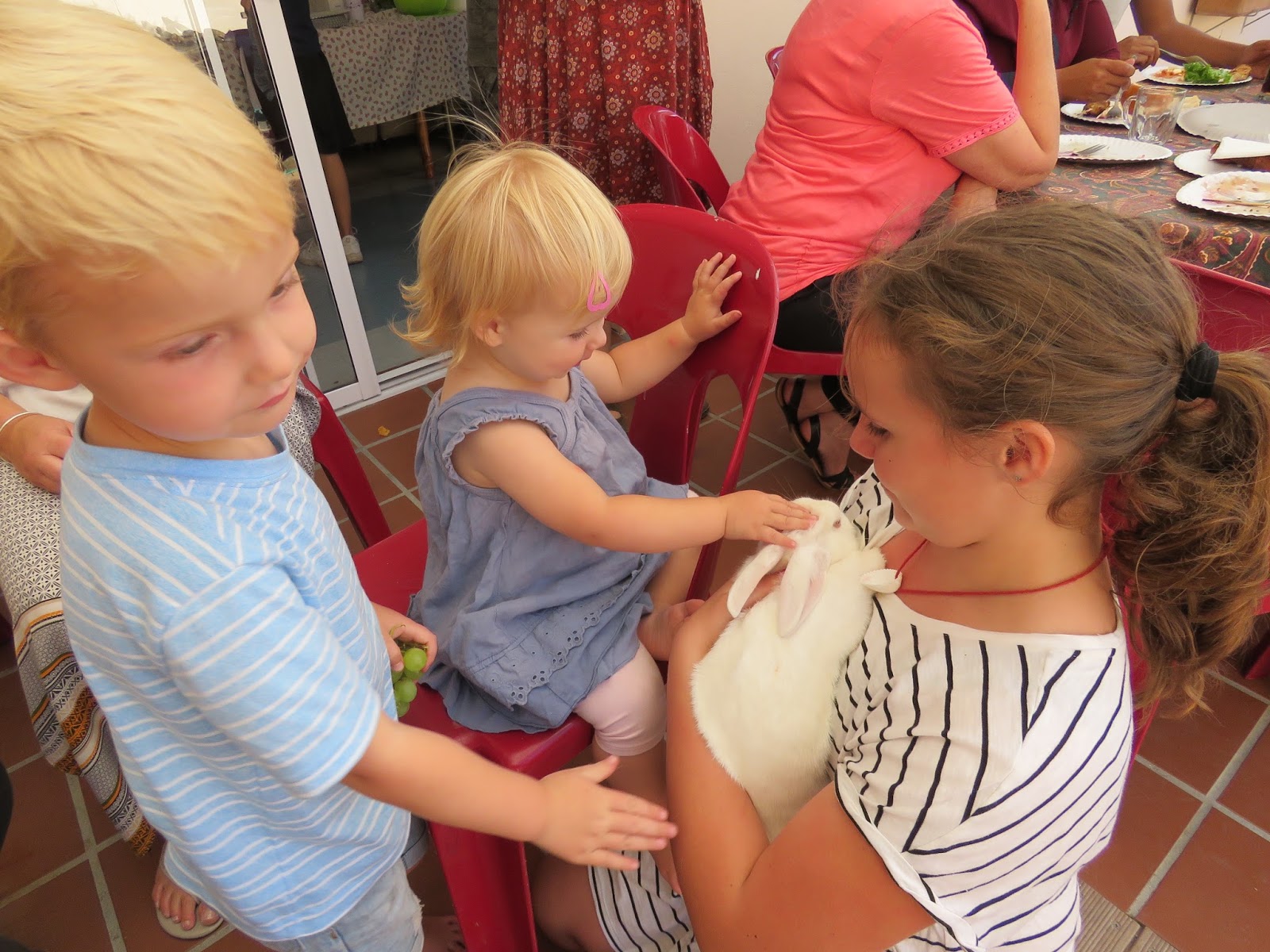
Beck se Plek is completely surrounded by the school building and this is where we keep our animals. From early in the mornings until late in the afternoons the animals are surrounded by multiage groups of children, alone or in small groups. The more severe ASD children tend to gravitate towards this space as soon as they arrive at our school because, usually for the first time in their lives, they can experience unconditional love from an animal. Our staffroom opens onto this quad and this has been such a bonus. Some of our ASD children initially struggle to work out ‘how’ to love an animal and so most breaks one of us needs to intervene. Comments like “No Ann, we don’t feed the ducks high above their heads to make them jump for the food. “ No Ann, we don’t hug a bunny as hard as that, just hold him gently in your lap.” “No Ann, we don’t kick the ducks out of our way. Remember this is their home and we are visitors here.” Sometimes children take about 3 years to finally understand the right behaviours. Over the years we have added to our animal ‘farm’ and currently have about 15 Muscovey ducks and 2 ducklings, 4 rabbits, all rescued, and 5 chickens and 3 pullets who live in this quad. This quad has also had a labyrinth drawn onto the brick paving in the centre.
Besides creating ‘spaces’ in the school, we have also adapted several other things within the school to assist all the ‘sensory sensitive’ children at our school:
- We have other animals in the school grounds, classrooms and offices. I encourage my staff to bring their puppies to school with them as I am involved with a dog club and know how important early socialisation is, for both dogs and children. Sometimes these puppies stay at school as older dogs, depending on their owners’ needs. We also have several tame birds - budgies, parrots and cockatiels which attend class with children who need their support. Many a child has been comforted by stroking a dog's head, while they confide in a staff member or comforted by a tame bird sitting on their shoulder while doing their classwork.
- We have adapted our uniforms to comfortable t-shirts and shorts, and our children don’t have to wear shoes at school – this particularly has made a huge difference as some children kick their shoes off first thing every day. Findings suggest that walking around barefoot benefits all brain development, and we certainly have found some children more grounded without their shoes. Two brain systems in particular, the proprioceptive (our sense of position and movement) and vestibular systems (our body balance and movement), rely heavily on the 'information' we receive from our feet. To create opportunities for different sensory input through our feet, we have also changed the 'flooring' of Beck se Plek - we currently have parts with bark chippings, a section of sand and other parts covered in gravel. We intend extending the different ground coverings as we either have some donated or we can afford to buy them.
We realised early on that support for just one child meant that many unidentified children with ASD also benefitted. More importantly, everybody is different so you don’t need to have a disability to enjoy not wearing shoes or lying on a couch reading a book during break time! I relish feeling textures with my feet so I would have loved to go barefoot at school, and school would have been heaven on earth if I could have read on a couch every break instead of having to make small talk out on the playground!
And so, we rejoice when different children arrive at Pinelands North. Every time a child arrives with different needs, we rethink our school spaces, policies and procedures to work out how we can better provide for all our children, as, by focusing on the needs of the individual, we make schooling better for all who attend!