Tuesday, 5 April 2016

Teaching children to be inventors

In a study in 1966, 24% of South African children could see themselves as inventors in the future, and of that group almost none of them were girls! I wonder how many children would think that today? I wonder if a larger percentage of the group would be girls? 
Problem solving with grade 3 pupils 
Paul Torrance says that children should be encouraged to invent things from as early as possible, and they should be encouraged to view a career in inventing as a positive option. Alexander Graham Bell was nine years old when he invented a talking doll which ultimately led to him developing the idea for the first telephone. Well known inventors like Bell actually invented things his whole life - his most famous invention is the telephone. We therefore mustn't think that an inventor has to be famous - most inventors invent things all through their lives, and few invent something as far-reaching as a telephone! Young girls need to see a future for themselves in science and in inventing things. This requires an inventive or problem solving mind, and a knowledge of scientific principles which would influence the situation around the problem to be solved. Very few people also realise that almost all inventors had a 'sidekick' - the person who might actually have done most of the technical planning or most of the actual doing to create the invention....remember Mr Watson?
So what do we do in our schools today to encourage children, particularly girls, to be inventors? In the old days inventors were taught drawing, observation and visualisation skills. Certainly the basics of those skills are taught from preschool at most schools. At Pinelands North we teach technology in several different ways to increase the opportunities of learning . This means that while most schools have one or two hours per week of this subject, we focus on Computer Technology, the specific skills needed for woodwork and needlework and on the theory of Technology. Our children also learn art and drama, and these subjects can also be focussed on in the extramural programme too. Communication skills are very important as an inventor because if you cannot communicate what you have invented it still won't be used or patented. 
Orals and projects about real inventors, their careers and their real stories is important for all to hear. The inspiration of people like Edison, Ford and Bell really cannot be underestimated - children love those stories of people solving difficult puzzles after hardship! Children need to know that a problem isn't going to be solved the first time you tackle it so perseverance and 'grit' are required, and often an inventor has to really persevere to sell the idea after the problem has been solved too. The 'new' idea is not going to quickly become a world wide seller immediately.  
Balancing 15 nails on one nail!
The emotional and social behaviours, and thinking skills of very bright children at Pinelands North are developed through our Creative and Talented Programme. The social/emotional  part of the programme encourages children to identify their emotions and learn to deal with the outside world in a positive way. In the development of their thinking, children have been encouraged to choose an inventor, research the inventor's life and then pretend to be the inventor, and give a speech that person might have given. This project was very successful!
An idea we haven't used as yet but intend to, is to ask children to make notes of the problems that are raised over 24 hours by their parents, friends or neighbours. After this they think through the problems, trying to think of solutions to some of them and then invent something to 'fix' the problem.
The truth of the matter is that even in our Creative and Talented Programme, we have more boys than girls, even though we are conscious of the need to identify girls. We see this as an ongoing challenge which needs to be addressed every time we consider adding children to our programme. Maybe we need to encourage more families not to stereotype girls from birth and to give their girl children technical problems to solve at an early age?

Wednesday, 30 March 2016

A public letter to the staff of PINELANDS North, at the end of the first hectic term of 2016!

Reflecting on the term gone by during the holidays,  I realize once again why I love teaching at PINELANDS North! My words at assembly at the end of the term are true - you are an amazing group of people, all different, from different backgrounds, with different roles to play....but with one purpose, and that is to raise our future South African children, gently and kindly! 

Here are some of the things I appreciate about you! 
You use gentle words when expecting our children to comply with our social norms. 
You teach what is supposed to be taught, according to curriculum, but you also teach a hidden curriculum of conflict resolution, of social justice, of empathy and of care for our fragile world. 
You treat the school as you would your home, so that when the school is under threat from outside, everybody is alert and watchful to ensure we are all safe. 
If you say you will do something, you do, whether that is ensuring there are chairs for parents in classrooms on school in action day, or calling parents to ask them to provide eats for functions. 
You notice dirty things and clean them, or you pick up litter without thinking that it is someone else's job. 
You set a good example to our children by the way you dress and the language you use at school. 
You treat all our living things at school, including our children, gently and with dignity. 
You care for each other, right across the school - someone is always holding someone else's hand while they are dealing with something personal that might have nothing directly to do with school, but affects the person's ability to be fully present. 

The list is endless because as I think of each section of our community, I could add more and more accolades. So, thank you, for the part you have played in the life of the school, and the part you play in making my life easier every day of the year! I appreciate you! 

Thursday, 10 March 2016

The importance of having animals as part of a school community....

Shannon with Cornflake
Since 2000 Pinelands North Primary has had a variety of animals at the school. Currently we have Muscovy ducks, 2 rabbits, several rats, a couple of fish tanks, several budgies, a German Shepherd puppy and a neighbour's cat who believes he belongs to us! Children engage with animals before and after school, and during break times, and help us with feeding and cleaning the animals. They learn to take responsibility for the life of an animal and the realisation that an animal relies on us for everything, starts an empathy process in children.
Angela with Sassie and Tyler
The children who benefit most from our animals are those in some distress. Often children who change schools in the years between grade 2 and 6, are those who have had some difficulty with schooling: either because of social issues, or because of learning problems. These children connect very quickly with our animals, and the relationship which develops from this connection, affects all the child's other school relationships positively. Children learn empathy once they have developed a relationship with an animal too, and this relationship then builds bridges between the child and the staff.
One of the first times we realised how important animals were, was when a new boy was throwing a tantrum in the classroom. His teacher noticed the class budgie in the cage close by, was sitting with his head cocked to one side and quietly watching. She told the boy that 'Buddy' was watching the tantrum and suddenly the screaming and antisocial behaviour stopped! This change in behaviour started a very positive process in behaviour change for this child.
Chane with Robert
Animals allow children to learn life lessons. One of the most  poignant times with our animals was when 2 really tame budgies died on one day, after being at the vet. Several grade 3 children had connected very strongly with these budgies and when they died, we spent most of the day counselling, having funerals and meditating quietly on how important they had become in our lives. One of the children who was affected the most by these 2 deaths, came to see me today to tell me that the cross they put up for these birds had been broken, and that he had fixed it for us - this incident happened 4 years ago! 4 years later this child was still remembering these budgies and how important they had been in his life!
Khayan with Lemon
Animals also have become rewards for progress at school. Particularly when children struggle with social interaction, having an animal as the reward for showing positive behaviours has met with great success. Children who struggle with human interaction often don't struggle to form good relationships with animals.
We have also had success in integrating children and animals when children have never interacted with animals before. Suddenly an animal is close but not threatening, and children learn that they can walk past a puppy without being bitten. Children who haven't ever had animals at home learn how to care for an animal in a nonthreatening way.
Kayden with one of our fishtanks 
Raaniyah with Liefie
The most interesting experience for me was one day when we had several teachers and principals visiting our school from the UK. I had about 6 ducklings in an open topped box outside my office in the passage when they arrived. As we walked by, the teachers gasped, and on investigation, I was told that none of them would ever have ducklings in the passage outside their classrooms - they would fear for the lives of the animals! I then realised what a special school I was at - I didn't ever have to fear children and their behaviour with animals. We were getting something right.....something which would positively influence the future of our population in South Africa!


Monday, 22 February 2016

Healthy Living


Fun run/walk in September 
Pinelands North Primary is committed to eating healthily, to selling or giving away only healthy foods, and to ensuring that all our children participate in activities which raise their heart rates! Far too many children today are eating takeaways and fast foods, and leading a sedentary lifestyle. There is an alarming rate of obesity in young children around the world, with this condition affecting children emotionally and physically as they get older. Children can't concentrate properly at school without good nutrition, and eating the incorrect foods sometimes causes behavioural problems in children too.
We encourage our families via newsletters and at public meetings to provide their children with healthy food to eat during the day. Families should try to include fruit, vegetables, protein and carbohydrates every day, and if they include bread, it should be the healthiest one they can afford. These are consumed during break times and during the 'Go Snack' time...usually half way between school starting and break time. These snack times give children the extra boost they need to focus on their learning.
Liquid refreshments should be available for children all the time, and the school recommends a water bottle with cool fresh water rather than fruit juice. Food provided at school should always be the best possible option. 
Our tuckshop has the seal of approval from the Heart Foundation and sells reasonably-priced good healthy food in case families don't have time to create healthy snacks the evening before. Our EarlyAct, the group of children who raise money for people less fortunate than themselves, also sell healthy food on Fridays but they do sell a few 'treat' items too. We also encourage party packs sent to school on birthdays, to be a healthy option. So parents could choose crunchies, popcorn, gingerbread or muffins instead of birthday cake. Our Red Connect parent group serves healthy foods whenever they provide snacks at school functions, and the only time you might see 'sugar' in its various forms, will be every second year at our Red-a-Fair!  Our families might also be pleased to hear that all our school functions only provide food that can be eaten by everybody! We have moved on from the time when people ate separately, and we need our children to learn to be accommodating and inclusive.
Using a piece of our new apparatus
We also encourage our children to 'dispose' of their food in an inclusive way. Any uneaten sandwiches or snacks are taken to our school kitchen so that any child, who may have forgotten lunch or doesn’t have any, can go and collect something to eat there. Spare leftover vegetables or fruit are fed to the school ducks or put into our school worm farms. Boiled eggs are given to the canaries and the finches, and bread crusts to the wild birds.

To encourage children to eat the food they might otherwise not eat at home, an idea would be to buy them a really great lunchbox and water bottle. Cut vegetables and fruit into small pieces, and cover with lemon juice if your child won't eat 'brown' fruit. Discuss school lunches regularly with your children. Do you need to adapt their lunch to their changing needs? Children should have enough food for both breaks if they are older than grade 2, and if they are in grade 1 and 2 and they do extramurals after school, they will also need extra snacks for the extra time they are at school. Packing a healthy lunchbox, day in and day out, can be a real challenge. It doesn't take long to run out of healthy and delicious lunch box ideas. Pinterest and FaceBook have lovely ideas which are easy to make but really good healthy options - sometimes even giving it to your child in a different way, might encourage them to continue to eat 'boring' foods!
One of the 'Dads' races at our sports day
Healthy living includes exercise. Pinelands North offers many different options to make
 children move - from table tennis to swimming, from team sports to individual ones. Because we know every child is different, parents should encourage their children to tackle several different sporting codes - not only to see if they have a particular talent, but also to encourage other life skills like teamwork, perseverance and empathy. Every child should move for as many hours as possible per day. Early encouragement of sporting activities, even just outside play, should be part of every child's daily plan.

Foundation Phase gala
In 2015 Pinelands North staff arranged a GoKart Derby Day to raise funds to build more playground apparatus so we now have a circuit built on the field which can be used for physical education classes or just for children to strengthen their upper bodies or learn to balance during break times. This year we will have another of these Derby Days to raise funds for a 'floor' covering for this circuit so that, should a child fall off the equipment, they won't be too badly hurt. Healthy eating and exercise together affect children positively and a child who is eating well and keeping their heart rate up, rarely suffers from depression.  Give your child the best possible starts to life as, making healthy living a habit, lasts a lifetime!


Thursday, 11 February 2016

Eating the' inclusive' elephant, one bite at a time.......

Ethel Jones teaching Ayden how to knit 
In my professional reading recently, I came across an article written by Gary Bunch in 2008. He wrote the article after having studied inclusive schools around the world, particularly those in Canada. He found patterns emerging in schools where inclusion was successful, and where it wasn't, and after analysing the data, he felt that there were 10 criteria which were essential in inclusive schools.  
Schools who were successful had a questioning attitude. Someone starts the process by asking in their own heads, why children with special needs should have to be taught separately. Where questions were asked and re-asked, the chance of the school being inclusive, is higher. Questioning needs to be seen as the first key for inclusive change. 
Schools who were successful in the inclusive field, had a leader who encouraged leadership in others. Leaders who see leadership in others, create an opportunity for people to step forward. At Pinelands North this is very evident, as leadership is encouraged through all sectors of our school - in classrooms, on the sports field, in aftercare, in music, in the admin department and in the library. When people accept leadership roles they become invested in the whole operation, not only in their own sector.
Grade 7 Amy reading with Isabella in grade 1
Respect for humanity is at the heart of inclusion. This respect is despite difference, and for all people as learning individuals. At inclusive schools there is traditionally a higher level of learning and socialisation. At Pinelands North the desire to learn and all attempts at learning are respected, whether the 'learner' is a pupil who is smarter than the rest, or a staff member who needs to be supported to learn to drive a vehicle.  
Respect in inclusive schools is not only given to those who 'can' learn or for those who learn the most. At Pinelands North our learning community is about everybody in the school learning at their own level. All pupils need to learn what they can, and in the way they can, and not be 'pitted' against an average! Every act of achievement is celebrated, and just striving for learning is also worth celebrating! We have found that in supporting the learning of everyone, we do not diminish the learning of anyone but rather enhance it all!  
Most people in education fields around the world measure learning against a set curriculum and so only those learning at the pace of the 'average', are seen to be learning! At Pinelands North all pupils are accepted as pupils learning at their own levels, at their own pace and therefore worthy of celebration! Each individual child's pace of learning is accepted as perfectly 'normal'! Learning is not seen as a competition or a race that only a few can win. We mustn't forget that as toddlers we all learnt to sit up, walk and talk at different times - why then do we think that suddenly we all will perform the same learning in the same timeframes?  
Lisa and Matt learning to draw
What we have learnt too, is that every teacher knows how to teach. This is not the skill that needs to be enhanced in the classroom, but instead it is the confidence of teachers in their ability to teach every child, at his or her own pace. Our teachers were also scared of this initially but once you start teaching in an inclusive environment, you realise that all we might need to change is the speed of our teaching- either faster or slower or both! This is where teachers need to be able to accept support from volunteers, parents, and other teaching staff. At the beginning of each year at Pinelands North, parents are asked where they would like to contribute to our learning community. This results in grandparents, older siblings, unemployed or stay at home adults in families all participating in classrooms, assisting our teachers and pupils. We accept help from overseas teaching students and volunteers, from NGOs and from neighbours!  
Usually schools have a 'one size fits all' curriculum but inclusive schools like Pinelands North, see the curriculum as a flexible tool, to be adjusted to every child's pace of learning. This allows access to learning for all "learners'! Collaboration between sections in school has a part to play in everybody's learning. At Pinelands North pupils work with other pupils, and pupils work with other adults besides teachers. Walking around the school, I often see a child working in the finance office - not because the child has been 'excluded' from their own classroom, but because that safe space is best for them in their present learning! Examples of this are seen everywhere in the school - on the field, in the garden, in the aftercare during the school day and in offices. In inclusive schools, nobody has all the answers but everyone works with determination towards finding the right support for every child - either through parents or volunteers or admin staff. The whole school must be determined to learn and assist with everybody's learning. 
The final pattern Gary Bunch noticed was that schools who were successful just got started! They didn't wait for someone to tell them what or how to do it, they just translated their thoughts into action. There is a little 'joke' that asks: 'How do you eat an elephant?' And the answer is 'One bite at a time!' If a school starts with little steps, inclusion can happen progressively.
Pinelands North has been on the 'one bite at a time' trajectory for almost twenty years and we are still learning something new every day...in fact, one thing we have learnt is that the 'inclusion elephant' is so big, that no school can ever say they have it all right! Pinelands North though, is determined to persevere until all excluded peoples are included as much as is humanly possible! 

Monday, 22 June 2015

The Evolution of a Primary School Principal

In January 1997, I started my journey as principal at Pinelands North Primary School. I remember my first few days vividly. Before school officially started for the year, I went in to acclimatise to my new position. Sitting at a large brown desk, in the middle of a dark blue and brown room, I realised the enormity of the task facing me. I could make or break this fragile community depending on how I tackled my tasks in the next few weeks. 
Only now do I realise how true that thought was, and how much effort and time has been expended in trying to ensure that this 'fragile' community is no longer fragile but exceptionally robust and hopefully, enduring, long past my tenure.
After about a year I also realised how much faith the Governing Body of this school had in me when they decided to appoint me.......I was, after all, a woman and women did not run co-ed primary schools in 1997, and I was only 37 years old too! So, a young woman.....with spiky hair and short skirts.....many would have seen this as a recipe for disaster! Luckily they didn't!
One of the first things I did was to get my caretaker to paint my office lime green.....this colour has energised me for 18 years, and is also now fashionable, but at that time, my staff were exceptionally rude about the colour - it was too bright, it gave them headaches or blinded them! I then moved my enormous desk into the corner behind the door...another really good decision that has been constant over the years. At that time, that too was rather a radical decision. Principals were figures of authority who needed a big desk placed between them and any visitor. I then scoured the school storage areas for comfortable chairs, bought a coffee table and placed those in my office as preferred places to entertain visitors.

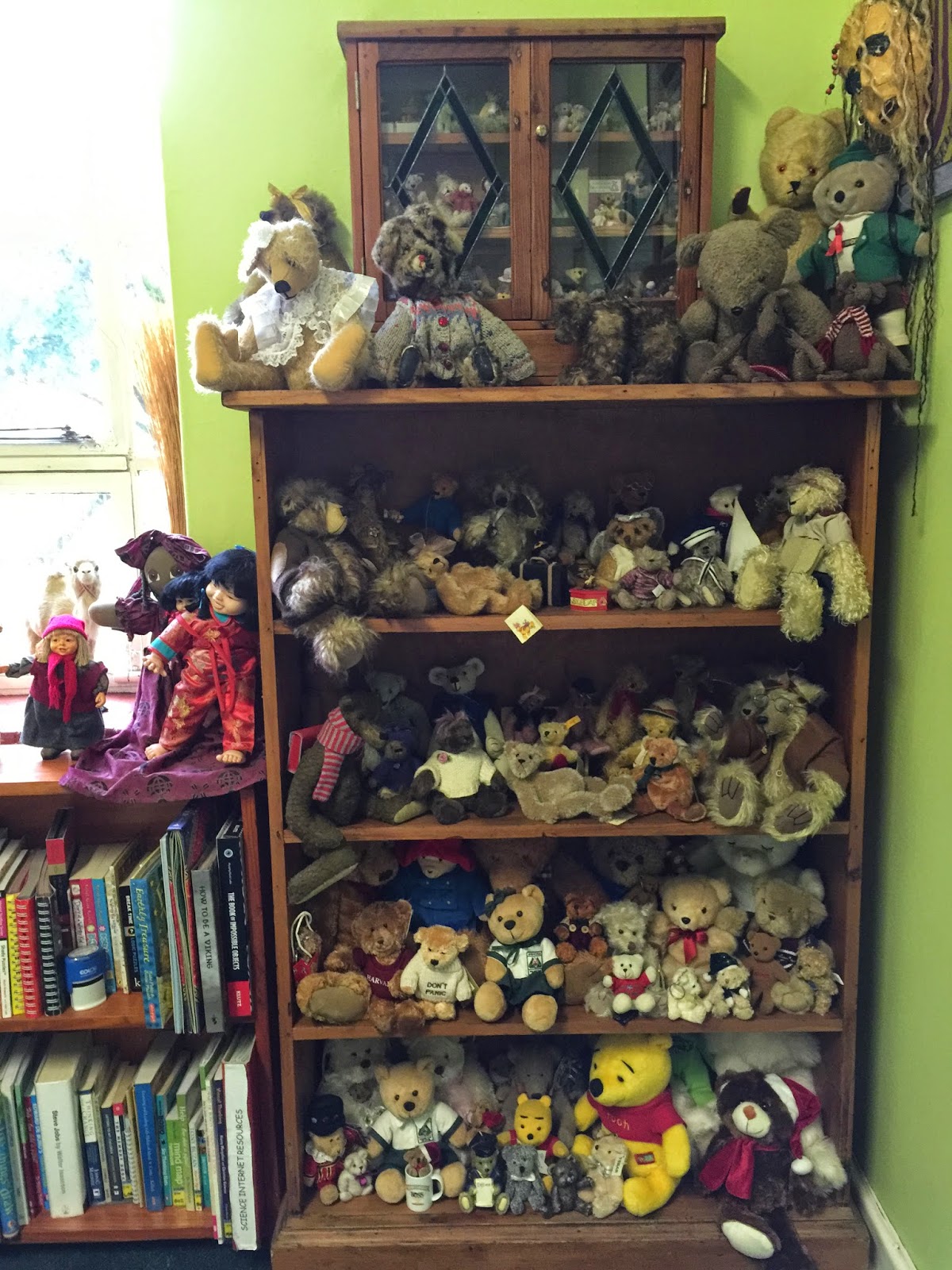
Over the years my office has become very much my home from home. I have lots of bright children's art on the walls, a huge bookshelf filled with teddy bears as I am an arctophile, and my pin boards are dark purple. This is definitely my happy space!


Changing the face of the rest of the school was much harder, as I had to consider other staffs' choices. Intense discussions were held over the colour to paint the classroom doors as they had all been white before.....and some teachers insisted on theirs remaining white! When I look now at the maroon pinboards, the shiny tiled floors and the beautiful children's work displayed outside every room, I am in awe of how far we have come! The foyer was also an important project which took slightly longer as it needed a fair amount of money to upgrade....now there are terracotta tiles, a kelim, beautiful art, freshly upholstered furniture and birds, plants and fish to encourage visitors to relax and feel at home too.

On the first day of school for staff, I was exceptionally apprehensive. At that point I still felt that I had to 'please' my staff so I 'requested', 'asked' and 'encouraged' teachers to start changing their interactions with children from authoritarian to co-operative. Detention and punishment were still very much on the agenda, and most staff felt that if they didn't have the option of this punitive approach, the children would not perform or be respectful. 
One bit of advice I was told by a former mentor was to ensure that my staff called me 'Mrs Morton' as this was a way to ensure that there was a respectful relationship between me and the staff. This advice I ignored completely and luckily I have never had reason to regret this decision!
The way I operate as a leader in this community is very different now. I am never timid, although still at times apprehensive! I believe that I cannot be timid when so much is hinging on the outcome of every single decision we make. I need to be decisive when this school community might be affected adversely by a single incorrect move. Every time we employ a new staff member they attend a year of new staff meetings, to integrate them fully into our society as our values and ways of managing children, parents, volunteers, facilitators and the general public is very specific to Pinelands North. Although we are taught in management courses that democracy is good and autocracy is not, I have felt many times that I have needed to be autocratic for the good of the whole community.

Before I was sure of the way we were going, I was also more pliable when parents came to  complain to me about things happening in the school. I don't now disregard what they say, but because I am so sure that all our staff are teaching, loving, caring human beings who can make mistakes at times, I can diffuse difficult situations because I can see both sides of the story.

After 18 years at the helm of this 'still evolving' society, I am happy that we are on the right path, that we have created a unique society which is obviously very different from any other school society I know, and that is being seen in the education world as something to celebrate and copy as it works. Thank you to all those who continue to have faith in me, and in the greater school community...thank you for believing in us as co-creators of a new future for South Africa!   

Monday, 1 June 2015

The biggest compliment a teacher can pay their own school is to enrol their children

Teacher Chantal Petersen and daughter, Jorja
On returning from Simonsberg campsite in Stellenbosch with grade 5 and 6 pupils, I started to edit the photographs taken while we were away. I suddenly realised how many of our staff have children at our school...... In every few photographs, one of our teachers' children appeared! Contemplating this fact, I realised that every parent is concerned while their children are away from them at some unknown place. Several can't resist the opportunity to call the 'emergency' phone number on the school cellphone, to..... 'just check that my little darling is still fine'. The interesting thing is that we received no calls from staff members who also have children at camp with us....... 
When one is looking for the right school for your most precious possession......your children - you consider very carefully the pros and cons of every school in the vicinity......
Will they provide the best quality teaching?
Will they carefully consider the curriculum and choose the best to teach my child? 
Will they provide emotional or educational support when needed? 
Will the teachers treat my child as if my child is theirs? 
Will my child meet the 'right' kind of child at this school? 
Can I trust the teachers and management staff with my precious possession? 
If a teacher enrols their child at the school they are teaching at, they are actually saying that.....
...... they believe in the curriculum taught
.......they believe in the systems used throughout the school
The Botha twins, sons of Leroy Botha
.......they believe in the 'hidden curriculum' of values which is infused into assemblies and functions
and......that they believe that what they do every day, has value. 
In fact they are saying that the school they teach at, is the school they wish they had been enrolled in themselves!
Maybe, when you are investigating the best school for your child, the one question you should be asking the principal is, " How many of your staff who have children, have their children at this school?" 
Thank you to the teachers of Pinelands North, who have such faith in the school they teach at, that they have 'lent' us their precious children for seven years so that we can pass on the values we hold dear, so they can, in turn, influence the rest of the world they touch in the future....