Tuesday, 31 March 2015

Fleshing out our Mission Statement

PINELANDS NORTH PRIMARY SCHOOL
-provides a happy, healthy, homely, safe, yet challenging learning environment
- develops the whole child's full potential academically, culturally, socially, spiritually and physically, 
- builds a vibrant, reflective and committed staff team
- encourages committed parental support and involvement
- develops co-ownership and accountability among all stakeholders including the wider community and continually improves the range and quality of its academic and extramural activities.

It is said that an organisation should continually assess their mission and vision statement to ensure that it accurately continues to 'say who you are'. This mission statement was originally developed in about 2001, and bar a few very minor changes, has continued to reflect our school and it's ethos. 
So, herewith our thoughts on each part......


1. ‘provides a happy, healthy, homely, safe, yet challenging learning environment'
  • devise and continually review our school safety plan
  • remind all stakeholders of the Code of Conduct and Bullying Policy every year
  • make the school homely by keeping animals, growing plants, playing music etc.
  • train PNPS children in peer conflict resolution strategies
  • encourage all pupils to achieve all that they can through the personal comments written on reports and the message presented at assemblies and other general school gatherings
  • devise and implement HIV/AIDS policy, and support any families affected by HIV/AIDS
  • remind children and parents about healthy eating at school and at home, in newsletters several times a year. 

2. ‘develops the whole child’s full potential academically, culturally, socially, spiritually and physically’

  • hand out merit trophies to one pupil per class and one pupil in each specialist subject area, twice a term
  • hand out merit badges to four pupils in each class every week in assembly
  • give deserving music pupils merits too
  • send Teacher Pleaser awards to parents from every class, once per term
  • hold interclass competitions in various circumstances, to build class unity e.g. Easter egg collections
  • encourage all pupils to extend themselves academically
  • build community awareness among pupils and greater world by adopting charities or doing community work
  • emphasise subjects which will improve life skills and provide hobbies or employment for the future eg entrepreneurship, computer skills, technology, woodwork, needlework and drama
  • work proactively in school curriculum change
  • provide access to learning support to all children within the school
  • provide opportunities for inclusion in mainstream education to pupils with special needs
  • teach Life Skills in our school curriculum but continue to promote the ethos of good living.

3. ‘builds a vibrant, reflective and committed staff team’

  • promote extra curricular courses for all staff
  • evaluate all staff every year and encourage the further development of strengths and improvement in weaker areas
  • meet with new staff at least twice a term
  • employ the best staff for the position, regardless of race, colour or creed, yet actively try to make the staff complement reflect that of the pupil body
  • draw up a workplace skills plan and review it annually.

4. ‘encourages committed family support and involvement’

  • continually encourage and praise participation in Red Connect meetings and other school activities
  • keep parents informed of current and forthcoming events through weekly newsletters, School Communicator, website, twitter feeds and Facebook
  • include personal parent/principal interviews in the enrolment process
  • respond positively and attend to negative communication as soon as possible
  • provide opportunities for ‘family learning’ in school homework tasks and holiday projects  
  • encourage all parents to attend our annual School-in-Action Day, so that they see our school in action.

5. ‘develops co-ownership and accountability among all stakeholders including the wider community’

  • set up varied parent forums as the need arises 
  • use as many parents from our Parent Help file as possible
  • include parents in class and school discipline procedures
  • invite grandparents to a special day dedicated to them
  • visit 'feeder' preschools and create opportunities for them to visit us
  • initiate meetings of Pinelands’ principals and governing body chairmen to encourage greater co-operation and working together, to maintain the high standard of education in Pinelands.

6. ‘continually improves the range and quality of its academic and extramural activities'

  • enrol pupils in national and international standardised tests
  • promote PNPS to our 'feeder' preschools
  • annually review academic and extramural focus and success
  • actively include life enhancing skills/subjects in our curriculum eg drama for self confidence, life skills and HIV/AIDS education for personal growth and development.

Monday, 23 March 2015

Grade 7 Tour 2015

Our Ashton stopover
Monday started very early, with us meeting at school at 06h00! After packing the bus, we left for the N1 trip via Carlitzdorp and a short stop at Ashton on the way. The first learning of the tour was a visit to the Withoek Boerdery in Calitzdorp, to a friend of Mr Botha. Here we visited his vineyard to watch the final grapes of the season being harvested, and then we went to the cellar for lunch.
Duron and Duncan at the cellar 

We then continued with our journey, arriving in Oudshoorn for our visit to The Cango Wildlife Ranch, and a chance to see several big cats and crocodiles as well. We really had fun in the children's park too! After about an hour and a half we continued to the ostrich farm where, after a talk about the history of the ostrich farming industry, we got to hug ostriches, stand on their eggs and ride on them! A lovely braai supper was provided by the farm management, and then we swam in their indoor pool. This was indeed a highlight of our tour because they have a long slide the children use to enter the pool! The evening ended with us going to our accommodation at Kleinplaas - we slept in separate self catering houses so the children felt very 'grownup'. 
Visiting the ostrich farm

Tuesday started very early again, and after a shower and clean up, we packed the bus and went back to the ostrich farm for breakfast. After an amazing breakfast we had the chance to visit the curio shop and buy presents for our families. The next trip was to the Cango Caves! In two separate groups we went into the caves for the Adventure Tour, attended a movie on the history of the caves and then were able to go to the curio shop at the caves. After both classes had finished, the bus travelled back to the ostrich farm for lunch. Then we were off again - this time to the Plett Puzzle Park and finally at about 7 in the evening, to our destination - Harkerville Forest Lodge, close to Plettenberg Bay. After supper we collapsed into bed, happy in our new home.
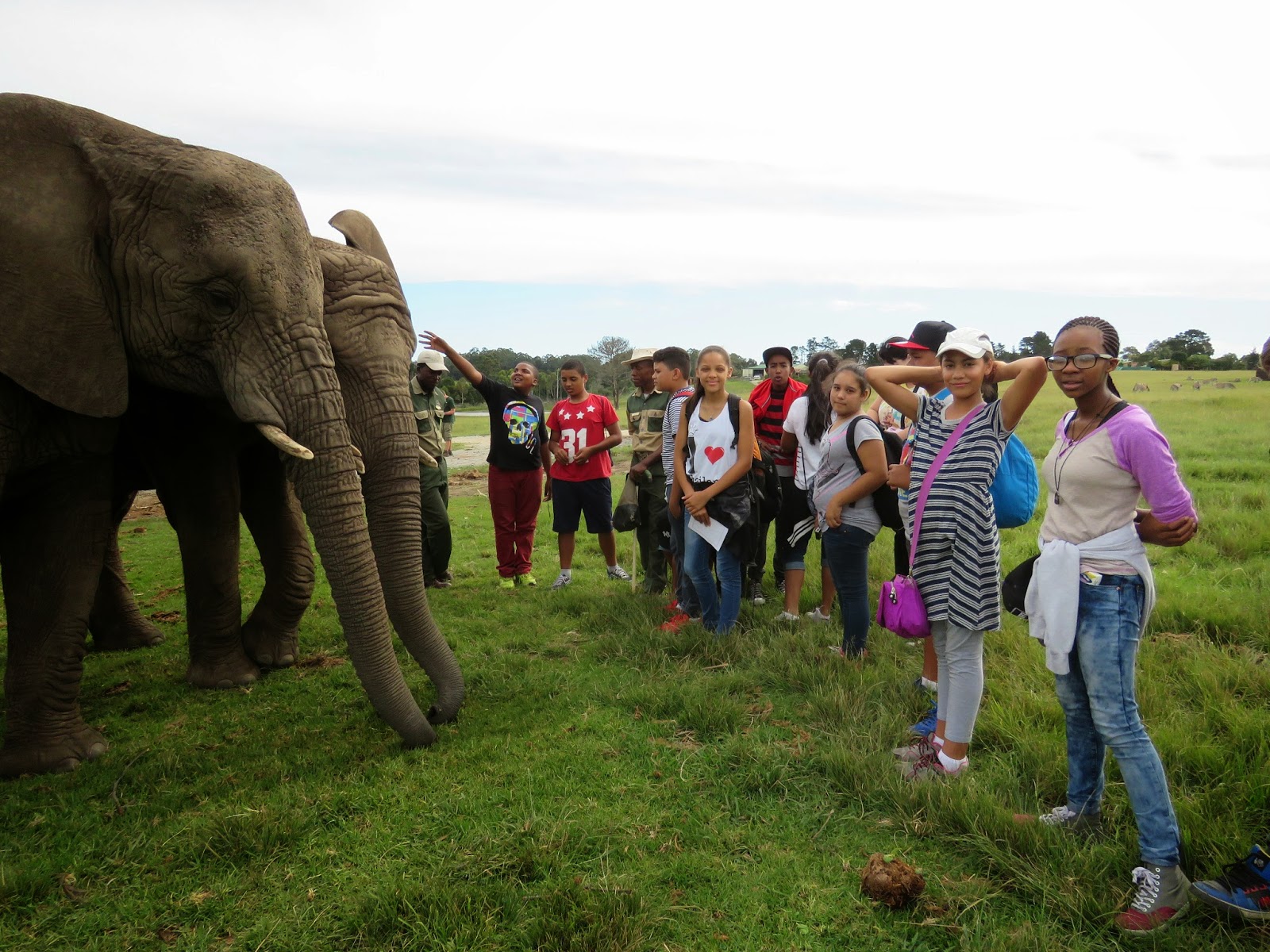
Visiting the elephants

Wednesday started with breakfast at the lodge and then the bus left for Monkeyland and the Birds of Eden. Both these visits were great.....we walked into aviaries and among the birds and monkeys which gave the children such a good perspective of their lives. Our next stop was the Knysna Elephant Park. For many this was a real highlight of the tour as we got to touch and feed these amazing animals after lunch. Later that afternoon we visited the Knysna Forest for the Eco-ED forest adventure and braai. The children learnt a lot about the Knysna forest and the animals living there, but also about leadership and trust, after having a chance to play the drums in unison! Our final task was the walk in the dark back to the bus, and then we travelled back to Harkerville and the comfort of our warm comfortable beds. 
Leroy with the barn owl

Riding on the tractor
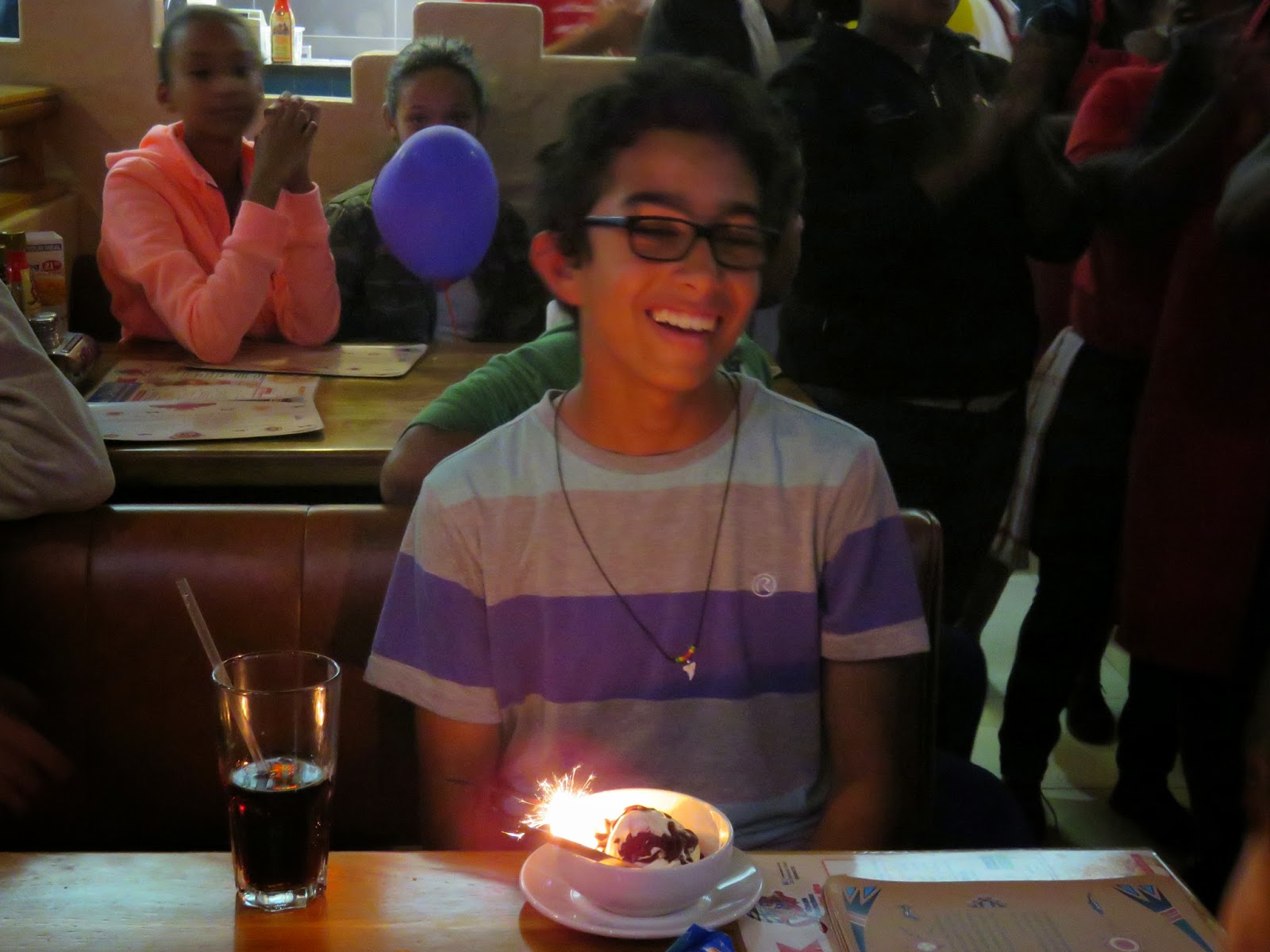
Breakfast at Harkerville and another trip by bus started Thursday! The first visit was to Radical Raptors. It was amazing to see all these birds of prey, out of their cages, flying above our heads. We then went to spend a few hours at the Adventure Land Fun Park where the children and staff zoomed down long water slides, floated on plastic tyres and generally had great fun. Lunch followed, back at Harkerville Forest Lodge, and then we left for Featherbed Nature Reserve. This was another highlight as we went across the Kysna Lagoon in a ferry, were taken up the hill on a tractor and trailer, and then hiked back to the jetty through beautiful milkwood forests. Afterwards we caught the ferry back to Knysna and then the bus took us to the Plettenberg Bay Spur for our final supper of burgers and ice-creams. And, as  Thursday was Noah Petersen's birthday, we got to sing to him there too!
Noah's birthday cake

On Friday we were very tired! After working so hard all week and not getting to bed early enough, we really dragged ourselves to get up, have breakfast, pack up and get into the bus on time. As we waved Harkerville goodbye, there was much sadness as we had really loved our time there! Noah's Wolf Sanctuary was our first stop before the trek home: there we met the resident wolf packs, had time to feed the 'petting zoo' animals, and hear about how wolves live in the wild. Mossel Bay was the first stop to have lunch - a takeaway pie from Pick 'n Pay - and then our journey continued to Cape Town. Most of us slept all the way back to school, and after meeting our families, promptly went home to sleep too! What an amazing week together!
Waiting to enter the caves

Thank you to all the staff who organised and accompanied the children on the trip, and to the children who again proved that our school teaches something unique - every time we travel outside of the school, the public spontaneously tell us that our children are well behaved, have beautiful manners and ask really good questions. Thanks for continuing to 'Aim High'!
Visiting Monkeyland


At the puzzle park


Sunday, 1 March 2015

The Importance of Electing the 'right' Governing Body

Later this month, all public schools in South Africa will elect a new Governing Body for a term of three years. Now is the perfect opportunity therefore, to ensure that the Governing Body your school selects, is the best one possible!
Lia Nizjink - current chair
School communities differ and so what is good, and possible, for one community, is not necessarily the best for another. School principals have a responsibility to their communities to ensure the best candidates are made available, and are voted in, so that their schools are enhanced by the Governing Body, not disadvantaged. I believe the principal's role in this is crucial. By this, I do not mean that we should be canvassing for the parents and staff that will follow the principal's lead meekly. I do mean that principals around the country should be advertising the elections weekly, on all communication platforms, should be emphasising the importance of the governors adding value to the school, and should be suggesting to those who might be interested that they meet with current governors to be better informed about the important role they play, in public education in South Africa. It is also crucial that the governing body reflect the school community so that all parts of the community feel that they are well represented.
Ko Bohms - treasurer
Tania van Rensburg -secretary
Governing body associations we are associated with; the Federated Association of School Governing Bodies, and the Governing Body Foundation, have been advertising these elections since the beginning of this year, trying to encourage parents to accept their responsibility for their local schools and to be involved. This advocacy can either be annoying or helpful to school principals, and the way they view this advocacy, is often through the past relationships they have had with their own previous governing bodies.
Mimi Xhantini - exemptions
I have been at schools in the past were a governing body has been a positive influence in a school, and also in schools where the governing body is seen as the enemy...In both these cases my experience has been that the principal has made the difference. When a governing body is 'feared' it is often because the principal 'uses' the governing body as a big stick - I heard of a teacher who was told that she should comply with an instruction or if she didn't, she would have to meet with the governing body to explain why she wouldn't comply...
The Governing Body Foundation have sent around a newsletter which gives the 'characteristics and capabilities' of those who wish to be nominated as governors: their list includes serving
  • in the best interests of the school not themselves
  • for the 'right' motives, not advancing their own interests
  • without reward for their services to the school
  • without expecting any advantage for their own children - academically or any other
This month allows schools to show the rest of South Africa, and the world, that democracy is alive and well. Please ensure that your school does reflect the South Africa that Nelson Mandela wished for us all!

Thursday, 26 February 2015

Catching children doing things right!


When I first arrived at Pinelands North, children were disciplined the traditional way. Corporal punishment was being outlawed in schooling so luckily I was never subject to 'administering corporal punishment 'on behalf of the school'. Children who didn't do their work were kept in - during breaks and after school, and if you really misbehaved, you attended 'detention', either after school or over weekends. One of the first meetings I ran in 1997 with my staff was a meeting on discipline....how were we going to jointly discipline the children at Pinelands North. I remember then trying to convince staff that detention wasn't really necessary......
Over the years, South African schooling and the world have rethought the way children's discipline should be handled, and now my ideas are not seen as 'radical' any longer. A few schools continue to administer corporal punishment even though it is outlawed, and most schools continue subjecting children to detention, the writing out of rules and lines, and to negative reinforcement. 
At Pinelands North Primary we practise positive discipline. This means that we focus on the positives that children do rather than focusing on the things they don't get right. Classrooms still agree to rules of 'engagement' at the beginning of the year, and these govern what is fair and right in each classroom. For example, when children show good manners, we praise them for remembering to do the right thing but we ignore 'bad' behaviour. When children are noticed and praised for doing something well, they naturally try to replicate that behaviour often. So, the reason our school children are so well behaved, we believe, is because we continually praise those who do the right thing. One of the ways we do this in the whole school, is by 'catching people in the act'. This can be done by children, parents and staff. If I therefore see someone doing the right thing, I would go to reception to find the little slip of paper to complete. The slip looks like this:


      _______________________________________________________________________________________

CAUGHT IN THE ACT

    __________________________________  Grade _____  was caught in the act of:

    ___________________________________________________________________
    
    ___________________________________________________________________

    Caught by _______________________________  Date   _____________________


       ___________________________________________________________________


After completing who I caught, and what they did right, the slip is placed on my intercom by the 'catcher' and then is read out to the whole school before breaks or after school. Everybody loves the public reward for doing the right thing! When these notes are read out daily, they remind children about the behaviours that the school community values: kindness, support, sharing, good conflict management and trying your best. We have noticed that it also builds self confidence in children - they love catching their teachers or the cleaning staff in the act, and bravely complete the forms for me to read. Focusing on the positive also creates a happier atmosphere for the school!
So please try to do this in your own home or in your business environment. You will feel less stressed by your children's behaviour and they will start to show you that they really do know how to behave. Try to catch your colleagues at work doing the right thing - adults also love the positive affirmation this brings!


Tuesday, 24 February 2015

ASHOKA accreditation

Early in 2014 Salma Seedat, a relatively new parent to our school, emailed me to ask if we would be happy if she nominated us for ASHOKA accreditation as a Changemaker School. ASHOKA is an international organisation which seeks to create and encourage world change through the development of core skills like teamwork, empathy, creativity and leadership. After agreeing to the nomination, the school had to fill in a very lengthy questionnaire, be visited by  three ASHOKA 'fellows', and finally four of our staff attended a four hour interview process! 43 schools in South Africa were nominated for this accreditation, 14 of those schools were visited and 7 schools went through the interview process! Only 4 schools in the Western Cape were eventually chosen - us being one of those 4! And so, on the first of October last year, Pinelands North Primary was awarded ASHOKA accreditation after this lengthy process. ASHOKA Changemaker schools all around the world are expected to teach empathy, critical skills in leadership and problem solving to solve social issues currently facing the world. As Pinelands North is inclusive, in the broadest view of the word, all our children are taught conflict resolution skills, and team work, and are expected to do their 'bit' to make the world a better place! Following up on our Ashoka accreditation as a Changemaker school, Ashoka made funding available for Maggie Lemere, an oral historian and storyteller, along with Nathan Golon, the director of Photography with  Goodfight Media, both based in Washington DC, to make a movie about our school. Pinelands North was chosen to represent all Changemaker schools in Africa, to show what is possible with limited resources and a  brave commitment to educating the whole child!
So, for one week in late November, they observed everything that our children and staff do, that makes our school the empathetic, creative, problem solving, socially aware school we are! 
The movie, with the main story line focussed on David White, the first pupil with special needs who was enrolled at Pinelands North in 1998, tells the Pinelands North 'story', and is now available on YouTube, Everyone a Changemaker: The Story of Pinelands North at  youtu.be/m92tLcVU6u8. The movie has been a hit with everybody......it has had more than 4000 views in just six days! I have received emails from complete strangers, all around the world, who have seen the 7 minute clip and been so impressed. Past pupils of the school have written to us to say how glad they are too, that the school from their childhood, is still making a difference in children's lives!

The movie has been playing in the school foyer for a few days, and several children have commented on their feelings having watched it:
"I think the video is amazing as it really shows a great view of the school and how we all work together!" Temwa Ngambi
"I think the movie was a great hit because everyone was happy and having fun, as this is the most amazing school!" Chane Thompson
"I found the short film spectacular, as it really showed the true beauty of the school and inspired me to make a short film myself!" Christopher Jehring
"The movie shows how the school guides children to achieve what they thought they couldn't!" Kaden Meyer
" I think the movie gives people the clear understanding that we are a happy inclusive school in a quality learning environment!" Matthew McFarlane